
 Ancient Egypt Home
Pharaohs
Egyptian Gods
Egyptian Pyramids
Hieroglyphics
Temples
Life in Ancient Egypt
Maps of Ancient Egypt
History of Egypt
The Queens of Egypt
Mummies
Religion
Cities and Regions
Ancient Egypt Facts
Ancient Egypt For Kids
Alexandria, Egypt: The Ancient City of Alexander
Last updated:
Alexandria lies in the northwest of Egypt, along the Mediterranean Sea. Alexander the Great founded the city in 331 BC during his conquest of the Persian Empire and named it after himself. He founded many cities called Alexandria, but none became as famous, large or wealthy as this one. For almost a thousand years it was the capital of Egypt and one of the great centers of learning in the ancient world.
Where Was Ancient Alexandria Located?
Ancient Alexandria stood on the Mediterranean coast of Egypt, at the western edge of the Nile Delta, in the same place as the modern city. Lake Mariut (Lake Mareotis in ancient times) borders the city on the south. Alexandria had harbors on both sides: sea harbors on the Mediterranean to the north, and a lake harbor on Lake Mariut to the south.
When the Greeks built Alexandria, the Canopic Branch of the Nile flowed close to the city. Canals brought fresh water from the river to the city and Lake Mariut. Alexandria sat on trade routes from the east, west and south. Under Roman rule, it was the port from which ships carried Egyptian grain to Rome.
Is Ancient Alexandria Underwater?
Partly, yes. The Alexandria of today is very different from the ancient city. The Canopic Branch of the Nile silted up by the 13th century AD. The coast has also sunk over the centuries, because the soft sediments of the Nile Delta compact over time and earthquakes have struck the region. In AD 365, a powerful earthquake near Crete sent a tsunami that flooded parts of the city.
Together, the sinking land and the rising level of the Mediterranean put most of the ancient shoreline underwater, including the royal quarter and the site of the Lighthouse. Archaeologists have mapped these underwater ruins in the eastern harbor. On land, construction work often brings ruins to light, so archaeologists have to carry out rescue digs before new buildings go up.
The History of Alexandria
What Was Alexandria Called Before?
Before Alexander arrived, an Egyptian settlement called Rhakotis stood on part of the site. Scholars disagree about whether it was a fishing village or a guard post. Little of it has been found, but sediment cores from the harbor suggest that people lived here centuries before Alexander. After the Greek city was built, Rhakotis remained the name of the city's Egyptian quarter.
Why Is Alexandria Named After Alexander the Great?
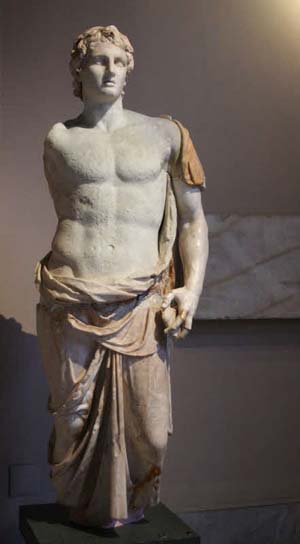
Statue of Alexander the Great
Alexander the Great chose the site himself in 331 BC and marked out the city's boundaries. Naming cities after himself was his way of stamping his rule on the lands he conquered. His architect, Dinocrates of Rhodes, laid out the street plan. According to the Greek geographer Strabo, the city stretched about 30 stadia (roughly 5.5 km or 3.4 miles) along the coast. At its height, Alexandria may have had 400,000 inhabitants or more, but this is an estimate, because archaeologists have not been able to excavate the whole city.
The Ptolemies
After Alexander died in 323 BC, his general Ptolemy took control of Egypt and made Alexandria his capital. Ptolemy seized Alexander's body on its way to Macedonia and buried it first in Memphis. The body was later moved to a tomb in Alexandria, which Roman leaders such as Augustus came to visit. The location of this tomb is still unknown today.
The Ptolemies ruled Egypt from Alexandria for almost 300 years (305–30 BC). The last Ptolemaic ruler was Cleopatra VII. She took her own life in 30 BC, after Octavian (the future emperor Augustus) defeated her and Mark Antony. Egypt then became a province of the Roman Empire.
Roman Alexandria
Under Rome, Alexandria was the second city of the empire after Rome itself. A Roman prefect governed Egypt from Alexandria, and grain fleets sailed from its harbors to feed the city of Rome. Alexandria stayed a center of learning, trade and religion.
The city had a large Jewish community; the Septuagint, the Greek translation of the Hebrew Bible, was made in Alexandria in the 3rd century BC. According to tradition, Saint Mark brought Christianity to the city, and Alexandria became one of the most important centers of the early Church. In AD 415, a Christian mob murdered the philosopher and mathematician Hypatia, an event often seen as a symbol of the end of the city's classical age.
When the Roman Empire split, Egypt became part of the Eastern Roman (Byzantine) Empire. Arab armies under Amr ibn al-As took Alexandria in AD 641, and the capital of Egypt moved to Fustat, near modern Cairo. Because the modern city is built on top of the ancient one, archaeologists can only excavate small areas, so much of Alexandria's history is still being uncovered.
The Culture of Ancient Alexandria
The culture of ancient Alexandria was a mix of Egyptian and Greek ideas. The Ptolemies brought sculptures and architectural pieces from Heliopolis to decorate their city. They blended some Greek gods with Egyptian deities and introduced a new god, Serapis, whose attributes came from several Greek and Egyptian gods.
Alexandrians decorated their tombs with Egyptian and Greek scenes, and scholars have found tomb paintings that blend the two artistic styles. Greek custom often favored cremation, and Alexandrian graves contain both bodies and cremation urns. Greeks and Egyptians were kept legally separate in many ways, yet mixed marriages did take place.
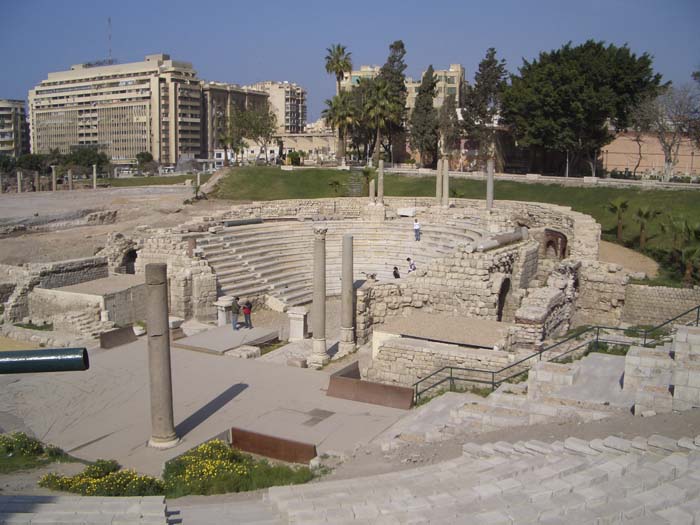
© Loise - The Ancient Roman Theatre in Alexandria
Ancient Alexandria's Layout
Ancient Alexandria was surrounded by city walls. Only fragments of the city's later walls survive today.
The city was laid out on a Hellenistic grid. Two main streets, about 14 meters (46 feet) wide, crossed the city, one running north–south and the other, the Canopic Way, running east–west. Other roads, around 7 meters (23 feet) wide, divided each district into blocks, and smaller streets divided the blocks. The street layout let the cool northern winds blow through the city.
Greeks, Egyptians and Jews largely lived in separate quarters. The royal quarter was in the northern part of the city, on the coast; it now lies under the water of the Eastern Harbor. The city's cemeteries (necropolis) were outside the ancient walls.
Wealthy citizens built villas along the shores of Lake Mariut, where they grew grapes and made wine. The harbors were built or expanded, and builders added breakwaters to protect them. A causeway, called the Heptastadion, connected the island of Pharos to the mainland. The famous Lighthouse of Alexandria stood on the eastern tip of the island to guide ships into the port.
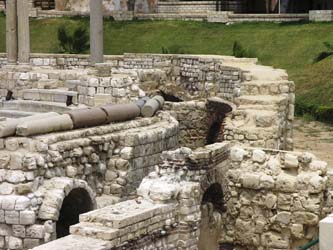
© Daniel Mayer - Ruins of the Amphitheater
The Lighthouse of Alexandria
The Lighthouse of Alexandria, also called the Pharos, was one of the Seven Wonders of the Ancient World. It was the only Wonder with a practical, everyday use. It was completed around 280 BC under the Ptolemies. Today its remains lie underwater, near the Citadel of Qaitbay. Scholars have a good idea of its size and shape from ancient descriptions, coins and images.
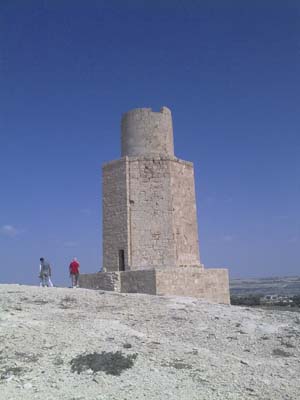
© Aymantarek24 - Scale Replica of the Lighthouse
Scholars estimate the lighthouse was more than 100 meters (about 330–450 feet) tall. It was built in three tiers: the bottom tier was square, the middle tier octagonal and the top tier cylindrical. A ramp led up to the entrance, and a staircase ran up inside.
Little is known about the beacon and the inside of the top two tiers. The lighthouse was damaged by several earthquakes, including one in AD 796, and its upper part had collapsed by the Middle Ages. Further earthquakes in the 14th century (notably in 1303 and 1323) left it in ruins. In 1477, Sultan Qaitbay built a fortress on the site, partly using its stones.
Ancient accounts suggest the beacon was a large open fire, and some describe a mirror that reflected its light out to sea. The shape of the very top is unclear: ancient records mention a statue, or a pair of statues, standing on top of the lighthouse.
Underwater excavations near the site have revealed statues, sphinxes and obelisks that the Ptolemies brought from Heliopolis. Divers have also found colossal statues, about 12 meters (40 feet) tall, of a Ptolemaic king and queen dressed as Egyptian pharaoh and goddess.
In some form, the Lighthouse of Alexandria stood for about 1,600 years.
The Library of Alexandria
The Library of Alexandria stood in the royal quarter. Ancient writers give very different figures for its size, from about 40,000 up to 700,000 scrolls. The Ptolemies bought or confiscated books from all over the known world; according to one story, scrolls found on ships in the harbor were copied, and the library kept the originals.
The Ptolemies wanted the library to be the center of knowledge in the Greek world, and many scholars worked there. Eratosthenes, its head librarian, calculated the circumference of the Earth. Euclid wrote the Elements, the most influential geometry book in history, and Archimedes is said to have studied in Alexandria.
The library declined over several centuries rather than vanishing in a single fire. A fire during Julius Caesar's war in Alexandria in 48 BC may have destroyed part of the collection. The Serapeum, a temple of Serapis that served as a "daughter library", was destroyed in AD 391. By the Arab conquest in AD 641, the great library no longer existed.
The Museum of Ancient Alexandria (Mouseion)
The Mouseion was the research institute of ancient Alexandria, the origin of our word "museum". It was closely linked to the Library and stood in the royal quarter. A mouseion was a shrine to the Muses, the nine goddesses who inspired artists, scholars and scientists.
Scholars at the Mouseion studied medicine, philosophy, astronomy and many other subjects, and students were taught there and in the Library. What became of the Mouseion is unknown, but its ruins may lie underwater today.
Other Buildings
Caesareum
Cleopatra began the Caesareum, a temple probably built in honor of Mark Antony (some sources say Julius Caesar). Augustus completed it and dedicated it to the worship of the Roman emperors. Two obelisks, later nicknamed "Cleopatra's Needles", stood in front of it. They were in fact made for Pharaoh Thutmose III, about 1,400 years before Cleopatra, and the Romans moved them to Alexandria from Heliopolis. Today one stands in London and the other in New York.
Cisterns
A network of underground cisterns lies beneath Alexandria. Fed by the canal from the Nile, they stored fresh water for the city. The largest have several levels of columns joined by arches. Archaeologists have located many of these cisterns, and a few have been restored.
Cemeteries
Catacombs of Kom el-Shaqafa
The Catacombs of Kom el-Shaqafa date to the 1st and 2nd centuries AD and were rediscovered in 1900. A spiral staircase around a deep circular shaft leads down several levels. The main burial chamber combines Egyptian, Greek and Roman art and symbols. The catacombs also have many niches for bodies and urns, and a banquet hall where relatives held funeral meals.
The Necropolis (Gabbari)
A rescue dig in the western necropolis at Gabbari revealed more than 17 tombs. Hundreds of niches cut into the walls held one or more bodies each, and burial urns stood on the tomb floors. Scholars believe these were the tombs of middle-class Alexandrians.
Alexandria Today
Alexandria is still a major city. It is Egypt's second-largest city, with more than 5 million inhabitants, and its busiest port. The Arabic name, al-Iskandariyya, still comes from Alexander.
Several places from the ancient city can be visited today:
- Citadel of Qaitbay: the 15th-century fortress built on the site of the Lighthouse.
- Catacombs of Kom el-Shaqafa: the Roman-era tombs described above.
- Kom el-Dikka: a Roman theatre, baths and lecture halls in the city center.
- Pompey's Pillar: a Roman column of red granite, erected in AD 297 in honor of Emperor Diocletian, on the site of the Serapeum.
- Bibliotheca Alexandrina: a modern library opened in 2002 near the site of the ancient Library, as a tribute to it.
Frequently Asked Questions About Alexandria
Who founded Alexandria?
Alexander the Great founded Alexandria in 331 BC.
Does ancient Alexandria still exist?
The city still exists under the same name, but most of the ancient city lies underneath modern Alexandria or under the sea in the Eastern Harbor.
Was Alexandria Greek or Egyptian?
Both. Alexandria was a Greek city founded in Egypt, ruled by a Greek-speaking dynasty, with a population of Greeks, Egyptians, Jews and others. Its culture blended Greek and Egyptian traditions.
Why was Alexandria so important?
Alexandria was the capital of Egypt for almost 1,000 years, a leading trading port of the Mediterranean, and the home of the Lighthouse, one of the Seven Wonders, and the most famous library of the ancient world.
Alexandria Facts
- Alexander the Great founded Alexandria in 331 BC.
- The Lighthouse of Alexandria (the Pharos), one of the Seven Wonders of the Ancient World, stood in the city's harbor.
- The Library and Mouseion of Alexandria were the leading centers of knowledge in the ancient world.
- The Ptolemies ruled Egypt from Alexandria for almost 300 years.
- Alexander the Great was buried in Alexandria, but archaeologists have not yet found his tomb.
- The remains of the Lighthouse and the royal quarter now lie underwater.
- People from Alexandria are called Alexandrians.
- Archaeologists are uncovering more about ancient Alexandria every year.